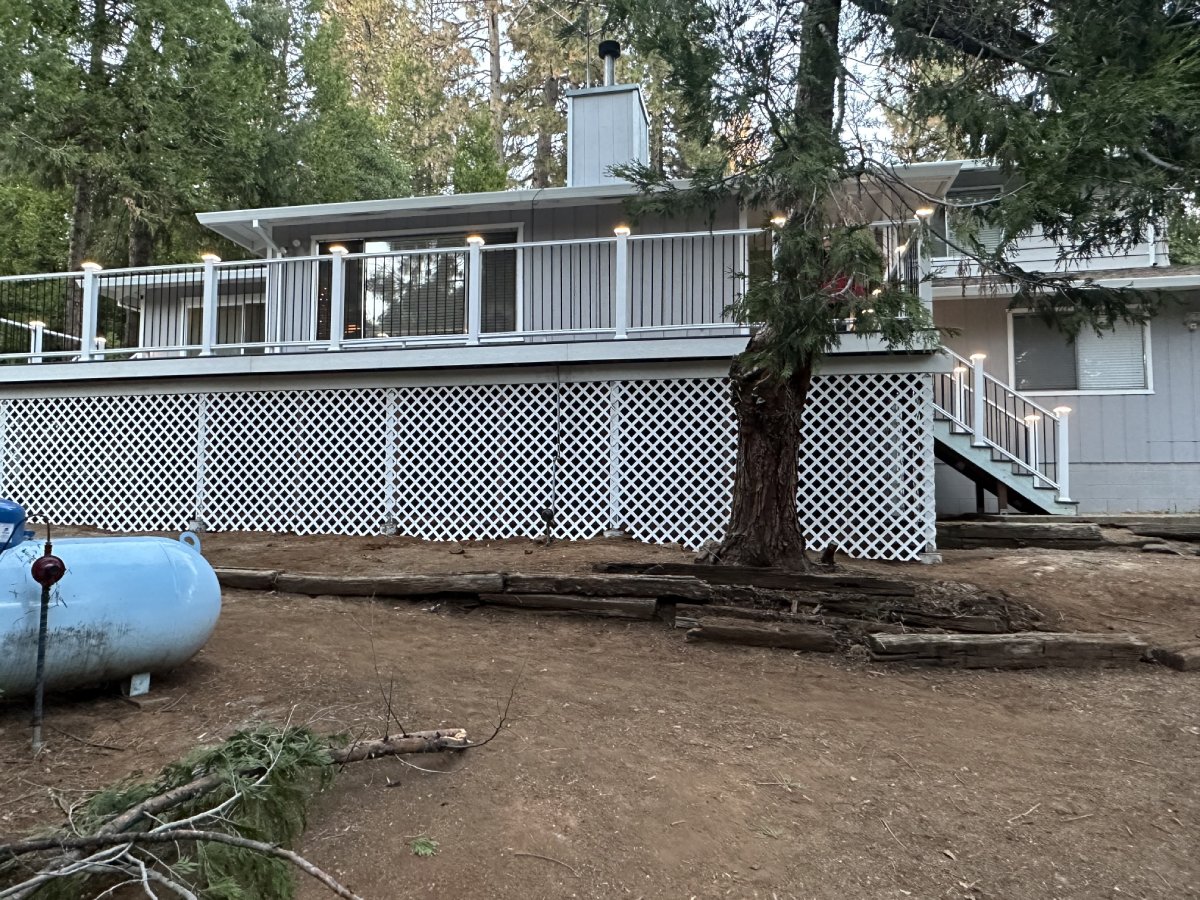
Building your own deck looks straightforward on YouTube. Most homeowners can absolutely manage a low, freestanding platform deck with a weekend of work and a stack of pressure-treated 2x6s. Where DIY goes sideways is on attached decks, elevated decks, and any deck that gets a permit — because the failure points (ledger flashing, footing depth, joist span, post connections) aren’t visible until they fail. Here’s the honest comparison.
When DIY Actually Works
DIY deck construction is reasonable when:
- The deck is freestanding (not attached to the house)
- It’s less than 30 inches off the ground (no permit required in most CA jurisdictions including Lodi)
- The footprint is under ~150 square feet
- The geometry is rectangular (no angled corners, multiple levels, or built-in features)
- You have basic carpentry experience and the right tools
For a 12’x12′ platform deck like this, expect $1,500-2,800 in pressure-treated lumber + hardware + concrete pier blocks, and 30-50 hours of weekend work for a first-timer.
When DIY Becomes a Bad Idea
Attached to the house. The connection point — the ledger board — is the single biggest failure point in deck construction. Improperly flashed ledgers rot the rim joist of the house, and improperly fastened ledgers tear away under load. Deck collapse statistics from the U.S. Consumer Product Safety Commission consistently show ledger failure as the leading cause.
Elevated more than 30 inches. Lodi and San Joaquin County require a permit, structural calculations, and inspection. Building without one means: no insurance coverage if someone’s hurt, problems at resale (lender appraisals flag unpermitted structures), and the city can require demolition.
Larger than ~200 square feet. Joist span tables get less forgiving as the span grows; choosing a 2×8 when the span called for a 2×10 means a deck that bounces today and sags in 5 years.
Complex geometry. Angled corners, multi-level platforms, built-in benches, planters, or hot tubs all require structural decisions a DIYer isn’t trained to make.
What a Pro Does Differently
Footings to code. Lodi requires concrete footings to a minimum depth that resists frost heave (usually 12 inches in our climate) and bears on undisturbed soil. Professionals dig past organic topsoil to native bearing soil and pour to spec.
Ledger flashing done right. Z-flashing tucked under siding, lapped over the ledger, with the joist hangers attached after — not before — the flashing is in place. Ledger lag bolts staggered per code (usually two rows, offset, with specific spacing based on load).
Joist hangers, not nailing. Every joist-to-beam and joist-to-ledger connection gets a galvanized or stainless joist hanger, not toe-nails. Hanger nails or screws sized to manufacturer spec.
Beam connections. Beams sit on top of posts (preferred) or are bolted to the side of posts with through-bolts and washers — never nailed. Post-to-beam connections use specific Simpson Strong-Tie hardware (or equivalent) rated for the load.
Hidden structural details. Blocking between joists at midspan, properly sized rim joists, double joists under any concentrated load (railing posts, stair stringers).
Composite vs lumber decisions. Pros know which composite brands handle Central Valley summer heat (some discolor or warp at 110°F) and which don’t.
Real Cost Comparison
For a 16’x12′ attached deck (192 sq ft) at 30 inches off the ground in Lodi:
- DIY (pressure-treated lumber, no permit): $2,800-4,500 in materials + 60-100 hours of your time. Hidden costs: mistakes-and-redo, wasted lumber, tool rentals, no warranty, no insurance coverage, no permit, lender flag at resale.
- Pro build (pressure-treated, permitted, code-compliant): $7,000-11,000 turnkey. Includes permit, footings to code, properly flashed ledger, all hardware, 1-year workmanship warranty.
- Pro build with composite decking: $11,000-17,000. Composite material costs 2-3x lumber but lasts 25-50 years vs 15-25 for treated lumber, and never needs sealing.
The Permit Conversation
San Joaquin County and the City of Lodi require a building permit for any deck attached to the house, any deck more than 30 inches above grade, or any deck supporting a hot tub or other heavy load. The permit process:
- Submit plans (a competent DIYer can draw them; pros include this in their fee)
- Pay fee ($150-450 depending on deck value)
- Wait 2-6 weeks for plan review
- Schedule inspections at footing, framing, and final stages
Skipping the permit is risky: discovery during a future remodel triggers retroactive permit requirement, potential demolition, and fines. Insurance often won’t cover injuries on unpermitted structures.
Hybrid Approach: DIY-Assist
A middle path that works well for Lodi homeowners with some carpentry skill: hire a pro for the structural work (footings, posts, ledger, beams, joists, permits) and DIY the decking, railings, and finish. This typically saves 25-40% versus full pro builds while letting the pro handle the parts where DIY mistakes are most expensive.
ADC Construction offers this as a structured arrangement — we’ll build the structural shell, get the inspections passed, and walk you through what’s left to safely DIY.
Frequently Asked Questions
Do I need a permit for a small deck in Lodi?
If the deck is freestanding, less than 200 sq ft, and walking surface is 30 inches or less above grade, you do not need a permit in Lodi. Anything attached to the house or higher than 30 inches requires a permit regardless of size.
How long does a permitted deck build take in Lodi?
Plan review: 2-6 weeks. Construction once permitted: 4-8 working days for a typical residential deck. Total elapsed time from contract to use: 6-12 weeks.
What’s the lifespan difference between treated lumber and composite?
Pressure-treated southern yellow pine: 15-25 years with annual sealing, 10-15 without. Composite (Trex, TimberTech, Fiberon): 25-50 years with no sealing, just occasional rinse-down. Up-front composite cost is 2-3x; lifecycle cost is comparable or lower.
Can I extend an existing deck myself?
Only if the original deck is permitted and the extension stays under permit thresholds (under 30″ high, under 200 sq ft addition). Otherwise the extension itself requires a permit, and the existing deck may need to be brought up to current code as part of the inspection.
What happens if I build without a permit and the city finds out?
A retroactive permit requires demolition of cosmetic finishes so the structure can be inspected. If the structure isn’t to code, full demolition. Fines run $500-2,500. The structure may be flagged on title and required to be addressed at sale.
How do I find a qualified deck builder in Lodi?
Verify CSLB license (B General Contractor or C-5 Framing). Check 5+ recent local references. Get 3 written line-item bids. Confirm the contractor pulls the permit (not the homeowner). Confirm workers comp coverage.
How much does it cost to add stairs to a deck?
Pre-built stair stringers (3-step set): $80-150 in materials, 4-6 hours DIY. Pro-built code-compliant stairs with railings: $800-2,000 depending on number of steps and material.
Ready to Get Started?
Building a deck in Lodi and not sure whether to DIY or hire it out? Get a real, line-item estimate from a licensed Lodi contractor.
Serving Lodi, CA and the San Joaquin County area. Learn more about our services, browse our recent project gallery, or read about our team.