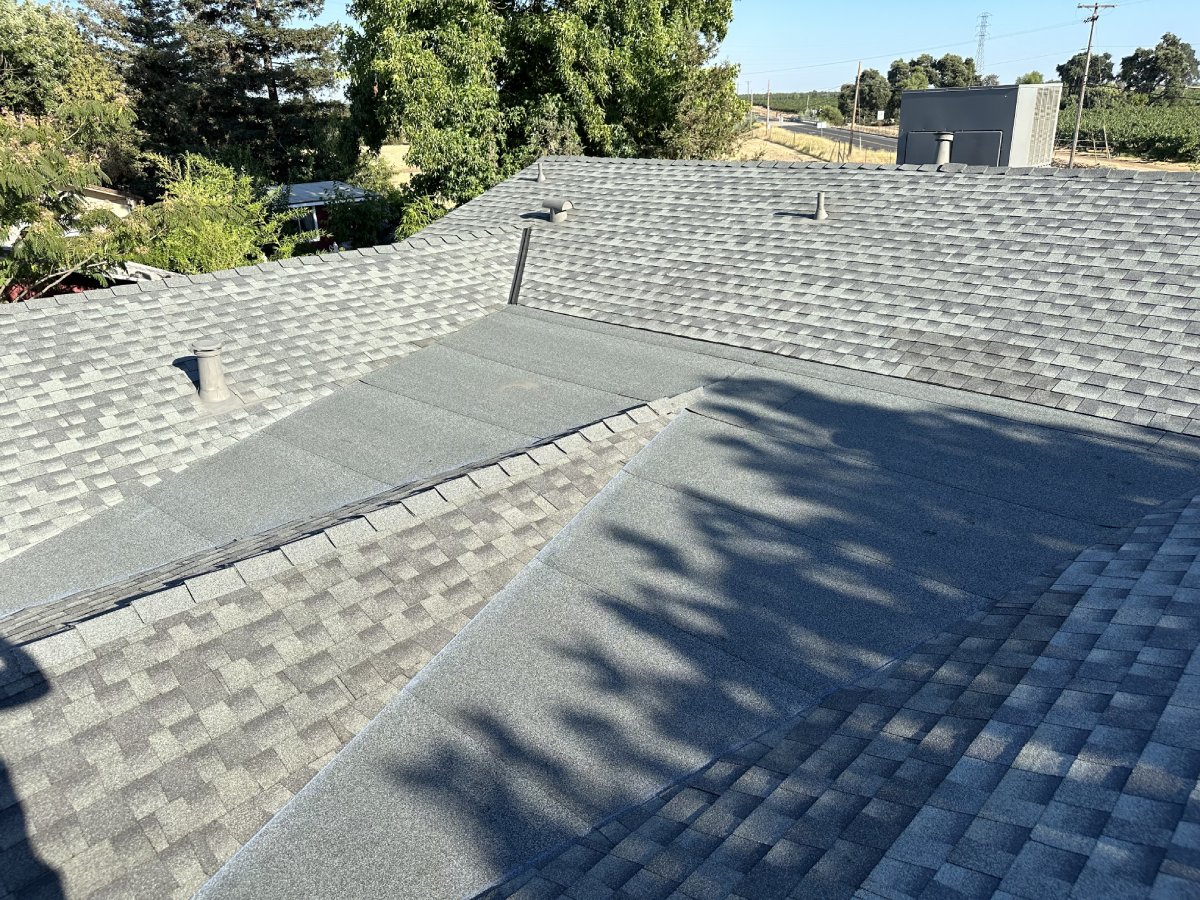
Galt Roof Replacement
Composition roofs from the 1990s and 2000s are wearing out after decades of Valley summers. We strip them to the deck, repair what we find underneath, and build the new roof for the heat.
How We Know a Composition Roof Is Finished
A lot of Galt roofs went on with the houses. The large tract subdivisions built through the 1990s and 2000s came with composition shingles, and many of those roofs have now spent decades taking summers that routinely climb past 100 degrees. Heat is what wears a shingle out in this part of the Valley, far more than rain does.
The first sign is granules. Those small mineral chips shield the asphalt from sunlight, and when they wash into the gutters and pile up at the downspouts, the shingle underneath starts drying out. Bare, shiny patches on the south and west slopes are the next stage.
Then the shingles change shape. Tabs curl at the edges or cup in the middle, and the ones that have baked out their oils turn brittle. On a cool morning a brittle tab cracks when you lift it.
A shingle that cracks under a hand will not hold through a gusty south wind in January.
Inside, look at the ceilings under the oldest slopes, and at the attic sheathing if you can reach it. Dark rings around pipe vents or along a valley mean water has been finding its way in for a while, usually longer than anyone noticed.
Out past the city limits, homes on the bigger rural lots near the farm ground and dairies sit in the open with nothing to break the gusty south winds of a winter storm. Many of them carry roofs that have been patched more than once, with a different shingle on every repair. Those roofs tell their story the minute we climb up, and the patchwork usually means the deck underneath has seen water more than once too.
We walk the roof, photograph every slope, and tell you whether it needs a repair, a few more years of maintenance, or a replacement now, with the reasons in writing.

Why We Tear Off Down to the Deck
A layover nails new shingles over the old ones and skips the tear-off, and it costs less on the day. We almost always advise against it. The new shingles take on the shape of the tired ones below, the extra weight sits on framing that was sized for one layer, and nobody ever sees the deck.
Seeing the deck is the whole point. Under a roof that has leaked even a little, the plywood or the old skip sheathing around vents, valleys and eaves is often soft or coming apart. On a tear-off we find it, replace it and photograph it, so the new roof goes down over solid wood.
Stripping the roof also lets us replace every piece of flashing and the drip edge in one pass, instead of trying to tie new metal into old metal that has already moved.
A tear-off is a loud, messy day, and we plan for that. Tarps go over beds and shrubs along the walls, the dumpster or trailer goes where you want it, and nails get picked up before the crew leaves each evening.
What Goes Under the New Shingles
Shingles are the part everyone sees. The layers underneath decide whether the roof actually keeps water out.
Underlayment
Over the bare deck goes underlayment, the backup layer that catches whatever wind drives past the shingles. In the valleys and along the eaves we add a self-adhering membrane that seals around every nail, because those are the places where water collects and moves slowest.
Drip Edge
Metal drip edge at the eaves and rakes carries water past the fascia into the gutter and keeps it from wicking back under the first course. On older ranches we often find none at all, with rotted fascia boards right where it should have been.
Valleys and Pipe Boots
Valleys carry more water than any other part of a roof, so they get metal or a woven shingle detail over membrane. Rubber pipe boots dry out and split in the sun long before the shingles give up, and every one of them gets replaced on a reroof.
Ridge Vents and Attic Heat
An attic in a Galt summer runs far hotter than the air outside. Balanced intake at the eaves and exhaust at the ridge move that heat out, which takes load off the air conditioner and keeps the shingles from cooking from underneath.
Other Questions a Galt Reroof Raises
These come up on nearly every job in town, and we settle each one before the crew arrives.
Cool-Rated Shingles
California’s energy code can call for a cool-rated shingle on a reroof. Whether yours does gets decided at permit, so the right product goes in the quote from the start.
Concrete Tile
On newer homes the tile often has plenty of life left while the underlayment under it has failed. We lift the tile, replace that layer and set the tile back.
City or County
Roofing permits for in-town houses come from the City of Galt. Country parcels get theirs from the County of Sacramento, and we file with the right one.
Your Plants
Plywood and tarps go over the beds along the walls before the first shingle comes off, and they come up after the last one goes on.
Magnet Sweep
We roll a magnet across the yard, the driveway and the beds so stray nails end up in a bucket instead of in a tire.
Final Inspection
The job closes with the permit inspection and a walk with you. Photos of the deck repairs and the finished roof are yours to keep.
Roof Questions Galt Owners Ask
How can I tell if my roof needs replacing or only a repair?
Judge the whole roof. Widespread granule loss, curling or brittle tabs across several slopes, and stains around vents all point toward replacement. One lifted section or a single cracked pipe boot on an otherwise healthy roof is usually a repair, and we will tell you that on the walk.
Do you ever do a layover?
Rarely. Nailing new shingles over old hides the deck, adds weight to framing sized for one layer, and makes it hard to replace flashing properly. Tearing off lets us find and fix soft sheathing before the new roof goes on, and on most Galt houses that is the job we recommend and quote.
Will I need a cool-rated shingle?
Possibly. California’s energy code can require a cool-rated product on a reroof, depending on the roof and the scope of work, and the answer gets settled when the permit is pulled. We check it before quoting, so the shingle listed in your quote is one the permit will accept.
My tile roof leaks but the tiles look fine. What now?
That is common on newer homes. Concrete tile can outlast the underlayment beneath it by a long stretch, and once that layer fails, water gets under the tile and into the deck. We lift the tile, replace the underlayment and flashing, swap out broken pieces, and relay the roof.
What happens to my yard on tear-off day?
Beds and shrubs along the walls get covered before work starts, the dumpster or trailer goes where you agree it should, and debris is kept off the lawn as much as a tear-off allows. Before the crew leaves each evening, someone rolls a magnet over the yard and driveway to pick up nails.
Do you handle the permit?
Yes, from whichever office covers the address: the city for homes inside Galt, the county for rural lots beyond it. We file the paperwork, schedule the inspection, and walk the finished roof with you once it passes, along with the photos of any deck repairs we made.
Work That Lines Up With a New Roof
A reroof is the easiest moment to fix whatever sits right below the eave. Rotted fascia and the bottom courses of old lap siding often turn up during tear-off, and we replace those under Galt siding installation. Where a missing drip edge has been dumping water down a stucco wall, the stains and cracks it left behind are a stucco repair job. If a raised deck off the back slider is on your list, deck construction explains how we set one on piers. A garage door baked by the same afternoon sun can be swapped through garage door replacement.
The rest of our work in town is on the Galt page. Roofing detail lives on our roof replacement service page, other towns we cover are under Sacramento County, and the gallery has photos of roofs we have completed.
Have Adam Walk the Roof Before the Rains.
Adam gets up on the roof himself, photographs every slope, looks in the attic where there is access, and tells you plainly whether it needs a repair, some maintenance or a full replacement. Whichever it is, you get the reasons and an itemized quote in writing. Reach us through the contact page or call to set a time.